JOHCM UK Equity Income Strategy
Size
EUR 2.57bn

This month brought further evidence that both UK consumer and business activity are improving and that the November 2025 Budget may have acted as a clearing event. Despite one of the wettest Januarys on record, retail sales again surprised to the upside, with volumes almost 2% higher and total sales up 5.5% year on year in January (excluding autos). Although consumer confidence fell back slightly in February it remains higher than it was a year ago. Conversations with housebuilders also suggested that viewings and reservations have been getting steadily better week by week so far in 2026.
This nascent improvement in housing activity should come as no surprise given the combined impact of interest rate reductions and more latterly the fall in mortgage rates due to lower bond yields. UK 2-year bond yields were down 19bps to 3.52% and 5-year yields were 25bps lower at 3.7%, their lowest level for 17 months. These moves were partly stimulated by a fall in inflation in January with the CPI back at 3.0% vs 3.4% in December. The reduction was driven by moderating food inflation (3.5% vs 4.4%) as well as the annualization of the increase in VAT on private schools’ fees. Whilst the Bank of England held rates, they reduced their forward projections for inflation for many of the reasons we have been highlighting, particularly the base effects in April of the National Insurance increase. With inflation set to fall to around 2% during Q2, further modest rate reductions look likely over the coming months.
The move lower in UK bond yields was also helped by another positive monthly public sector finance performance. January is always the strongest month for public finances due to self-assessment tax returns falling in the month, but the 2026 £30.4bn surplus was double that of January 2025, and £6bn better than the OBR’s November forecast. This was the highest surplus in any month since records began in 1993 (not adjusted for inflation). Borrowing for the financial year to date (the 10 months to January 2026) is £14.6bn, or 11.5% lower than in the same 10-month period a year ago. It is estimated by the ONS at 3.7% of GDP, 0.7 percentage points lower than a year earlier. These very strong numbers helped longer duration yields fall from their elevated levels, with the 20-year bond yield down 20bps to 5.0%. However, an “idiot premium” still persists in the UK due to a recent history of political mishaps and policy errors and the current ongoing political uncertainty means it may take a while to disappear.
Business confidence also continues to strengthen in the UK, which is reflected in the latest composite PMI reading of 53.9, suggesting a healthy rate of economic expansion. Within the detail, only construction activity remains below 50 (therefore likely to be contracting). However, this month also suggested an improvement is taking hold in this area, with a 6-point increase to 46.4.
Despite so many improving economic indicators, the majority of the “doom loop”- obsessed UK media - continue to focus on any ongoing negatives they can find, and, in this respect, the backward looking/late-cycle unemployment release gave them some material. Unemployment rose to 5.2% vs 4.4% a year ago, with levels particularly elevated amongst young graduates. However, the Labour report has been, by its own admission, somewhat unreliable in recent years with poor data collection and as such the numbers should be viewed with a degree of skepticism. It should also be noted that the rise in unemployment in the last 3 months has not been driven by more people being unemployed, but actually by an increase in the labour participation rate, with a higher proportion of the UK population actively looking for work. Notably, the number of vacancies in the UK has modestly risen over the last 6 months, suggesting a firmer market than the headline unemployment number suggests. Encouragingly, wage settlements continue to drift lower, with wage growth averaging +4.2% on a whole economy basis, last month and only +3.5% in the private sector. This is a key dynamic for the Bank of England in setting interest rate policy.
The events over the weekend in the Middle East, will have an economic impact, depending on duration and end result – we will discuss these in more detail next month, when the picture is clearer.
The strong performance of the UK market continued in February, with the FTSE All-Share Index rising 6.37%. The Fund lagged the market during the month, returning 4.18%. Year to date, the Fund is up 9.25%, which is slightly behind the market.
Looking at the peer group, the Fund ranked 7th decile in the Equity Income sector over the month, and 3rd decile year to date. On a longer-term basis, the Fund ranks in the 1st decile over 3- and 10-year periods. The Fund remains the best in the sector since its inception in 2004, and over the last 10 years (Source: Lipper as at 28 February 2026).
February saw the return of the extreme performance concentration, which was evident through most of 2025, with five stocks (AstraZeneca, GSK, Shell, Rolls Royce and HSBC) accounting for c. 60% of the market return. Of these names, HSBC and GSK are held in the Fund, with the others failing to meet either our dividend yield or valuation criteria. GSK (up 15% relative) delivered an excellent set of results under its new leadership, underpinned by growth in the Specialist Medicines portfolio, visibility over the HIV glidepath, and pipeline developments. Late in the month, HSBC (up 6% relative) reported better than anticipated results and upgraded guidance, whilst also announcing a higher-than-expected dividend.
Corporate action was a key feature of the Fund’s absolute performance, one positively, one negatively:
Schroders (up 22% relative) announced they had agreed to the terms of an acquisition by US-based asset manager Nuveen at a price of £6.12 per share, at a c. 35% premium. We purchased Schroders at c. £3.50 last year for the first time in the Funds history as the new management team outlined a 5-year transformation plan based around simplification and cost control. The business had been making good operational progress on the strategy, with the shares up c. 12% year-to-date prior to the bid being announced. Given that momentum, and although overall it is a good outcome, we are slightly disappointed with the premium paid. Our valuation, for a change of control situation, would have been 10-15% higher. Part of this dynamic is because of the controlling stake of the Schroder family, who were both the price setter and taker.
Johnson Matthey fell 21% in relative terms, after it emerged that the terms for the sale of Catalyst Technologies had been renegotiated down from £1.8bn to £1.325bn. Whilst disappointing, the reduced offer reflects the operational struggles of the business, which has seen profits at this unit fall c.60%, following policies implemented by Trump. We are confident that the deal will now consummate and is still a good outcome for shareholders. We used the immediate weakness to incrementally add to our position and believe the current share price materially undervalues the market-leading positions of the remainder of the group and the embedded growth optionality.
Other contributors to performance over the month include Vodafone (up 7% relative) who delivered a solid set of results and announced the sale of its 50% stake in VodafoneZiggo for €1bn cash whilst retaining a 10% holding in the new entity. This was materially above market consensus. Shares in Marks and Spencer (up 6% relative) and Curry’s (up 5% relative) continued their recent strong run, which we believe reflects positive trading trends. Construction names Keller (up 11%), Kier (up a further 2% relative) and Costain (up 5% relative) were also positive contributors. The infrastructure spend required across developed markets will continue to support the sector for the foreseeable future.
On the detractor’s side, our recruitment stocks (c. 2% of the Fund) PageGroup and SThree (both down c. 15% relative) continued to be weak. As discussed previously, we are beginning to see signs of improvement in their end markets, but the AI disintermediation threat remains the key short-term driver. Both companies are market leaders in their respective areas, have strong balance sheets, and are well positioned to benefit from any cyclical recovery.
UK banks also came under pressure post results (which were strong across the board) with Lloyds (down 4% relative) and Barclays (down 9% relative) both weak. NatWest (down c. 10% relative), which we exited last year on valuation grounds, was the sector’s largest faller following the announcement of its acquisition of Evelyn Partners. The weakness in the sector is primarily attributed to a combination of political uncertainty and investor unease over the potential that AI poses a longer-term structural threat to traditional banking models. We believe the ongoing application of technology and AI tools is materially improving banks’ service propositions and cost bases. We cover the latter below.
Finally, the Fund also benefitted in a relative sense from weakness in several void stocks, particularly those in the data and software sectors. We discuss this further in our outlook section but believe this represents a material change in market mix / leadership. These ‘quality’ stocks have traded at a significant premium for a number of years, but AI disintermediation is now fundamentally challenging the business models and assessments of terminal value. We see little margin of safety in their valuations and believe they remain vulnerable to further multiple contraction.
We added one new name to the Fund during February – the UK property stock Derwent.
Derwent trades at approximately a 45% discount to its forecast net asset value, offers a dividend yield just below 5%, and, importantly within the sector, maintains low leverage. Its assets are predominantly offices located above the London West End core zone, in slightly secondary locations but near the Elizabeth Line. The business model has hitherto focused on developing or upgrading offices and then largely holding them for investment income. It is noticeable that several of the long-serving executives, including the CEO, have recently announced their retirement or departure. With a new leadership team in place and valuation metrics at current lows, a strategy adjustment is expected.
In our view, a slight reduction in development, an increase in asset sales (which would prove out the overall valuation) and a share buyback are likely to be the focus. Results late in the month suggested the company is moving in this direction. This would, if enacted, push the valuation up. The closure of the discount to NAV to 20-25% would yield 50% upside. The stock is also vulnerable to corporate activity, given the low valuation.
To fund part of the Derwent purchase, we started to gently fade our position in Hammerson, which has performed very well. The stock now has less upside to our target price of c. 420-450p, which is based on a 2027 net asset value of c. 460-480p – materially above consensus expectations. Hammerson remains a core holding. In property we added to our position in New River Retail.
In the banking sector, before the Starmer related volatility part way through the month, we reduced our position in Lloyds, following a step through the 110p mark. Our target price is higher than this, but the sharp increase over the last 12 months has narrowed the residual upside. This was moved into Investec, where the position size is now 1.5% of the Fund. As we have explained in previous editions, after not moving in 2025 from a share price perspective, a large valuation gap opened versus its peer group. It also looks very attractive on an absolute valuation basis. We added to Barclays later in the month, following UK political volatility linked to leadership uncertainty around Prime Minister Starmer. Barclays reported strong results during the month and set new medium-term targets that were ahead of expectations and, in our view, highly credible. With this set of results, Barclays also guided the first step change in the dividend, up approximately 60% in 2026. We expect one further step change in 2027-28 given dividend cover remains very high (c. 4x). We also saw Standard Chartered deliver a step change in its dividend – up c. 60% for the declared 2025 dividend.
Elsewhere, several stocks, following strong performance, moved to lower dividend yield trajectories, and holdings were reduced accordingly. Keller, Curry’s and Marks & Spencer’s fit into this category. The last two of these, similarly to Barclays and Standard Chartered, are expected to see a material increase in dividends over the next few years, given high dividend cover ratios.
We also increased our weighting in Centrica following the fall in the shares after its results.
Near-term earnings were reduced due to the commendable policy of including restructuring costs in declared profit rather than treating them as an adjusting item. Trading profits were also slightly lower, although this remains the lowest quality component of the earnings base. Longer term, management are targeting a doubling of EPS by 2030 and a doubling of the dividend, which stands them out in the FTSE 100. Earnings quality is also expected to improve over this period, with a greater contribution from regulated activities and less exposure to finite-life oil and gas assets, which also results in a materially lower tax rate. The business has net cash as we stand today and will end the period with a higher cash balance, which is not reflected in valuation. The expected 50% increase in electricity demand over the next 15 years should also be a useful tail wind across many of its businesses.
A feature of both Centrica’s and the banking sector’s results is the use of technology and AI to reduce costs. For example, Centrica signaled a £2bn reduction in costs, which offsets inflation (£1.2bn) and creates space for investment (£0.8bn) whilst keeping costs flat. It is a similar story at large banks. The theme of our stocks being the beneficiaries of AI and other technological developments was quite vivid during the first part of the results season.
Elsewhere, we continued to slowly reduce our holdings in the three contractors, effectively harvesting the recent moves in the share prices and moving the weights in the Fund back to where they were. Costain (which was promoted to the FTSE 250), Galliford Try, and Kier are up 30-55% relative over 12 months. Some of the proceeds were rotated into our two holdings in UK brick companies. These have performed poorly; for example, Ibstock is down 41% on a 12-month relative basis. On normalised EPS forecasts, both Ibstock and Forterra could approximately double from current share price levels, assuming just 200,000 new homes are built annually, whilst assuming an exit PE of 12x. Further interest rate cuts should support the housing market. Demand-side measures from the Government, including discussion of a potential variant of the Help to Buy scheme, also increased markedly in February.
The start of this year has been one of the most interesting of any period since we have been running the Fund. The rate of news flow, the rate of change, a restart of M&A, political volatility, and the acceleration in AI have led to a material shift in market leadership over the past few months - one that, in our view, is likely to persist for years rather than prove temporary.
By and large, as we have said for the last 12 months, our holdings are on the ‘front foot’. We saw this again through February as the first half of the results season fed through. This theme is being driven by multiple drivers, which we depict on the slide below. These drivers are leading to growing earnings, upgrades, higher valuations, and higher target prices. This is a very different scenario to much of the last 20 years, where target prices were more static due to a lack of positive drivers. This rolling value creation is very important when thinking about future Fund performance in both an absolute and relative sense.
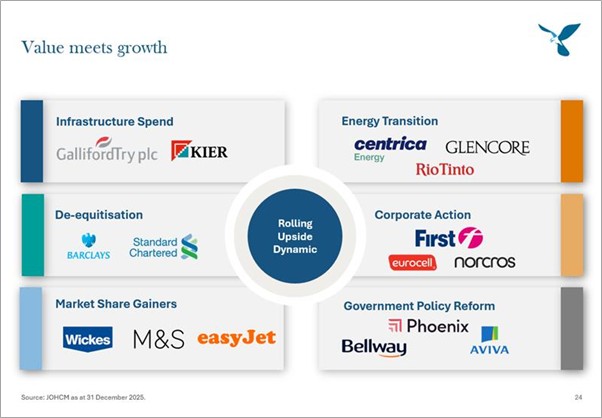
This rolling value creation is further supported by the UK economic picture. It is stronger than consensus expectations and mainstream media coverage suggests and is likely to be sustained by lower inflation and continued interest rate cuts. On the latter, our central case would be for a further 50bp reduction this year, but there is a probability that the MPC will pause after a March cut (25bp) given the economy is stronger than expected. This would, however, be a pause for good reasons. As we have highlighted several times, the UK consumer / corporate balance sheet – in terms of cash / savings / liquidity – is the strongest it has ever been. This c. £600bn ‘buffer’ would accrete growth materially were it to start to be utilised. This broad economic picture is not built into management thinking at a corporate level, or their guidance to the market or valuations. Several government policies could be announced that would be materially positive for Fund performance e.g. a form of Help to Buy 2 in the new housing market. The main short-term risk is uncertainty around Starmer’s position as Prime Minister, and of course the situation in the Middle East. On the final day of the month, the Green Party won the Gorton and Denton by-election, pushing Labour into third place in an area they had previously held since 1931. We continue to monitor political developments carefully but observe that markets have reacted calmly to the result.
The other theme of the results season was the overall strength of dividends at an aggregate Fund level. A few of our top 10 holdings announced materially better dividends as noted in the sections above. We will formally update the Fund dividend guidance at the end of Q1, but the risk is on the upside.
From a broader perspective, the Fund has two main void areas – (a) highly rated stocks that are deemed to be high quality, that have a material and / or unknown AI risk and (b) consumer staples. These parts of the market are coming under increased pressure / scrutiny.
On the former, February could go down as a seminal month, with materially better AI models and solutions released, that challenged the business models of many stocks that have hitherto been highly thought of and consequently highly valued. We will leave others to comment on the validity and extent of the likely ultimate pressures, but AI developments have raised legitimate question marks over the terminal growth rate and hence terminal value of these stocks. At best, the ratings of these stocks will remain under pressure and will be unlikely to return to where they came from. At worst, there could be substantial earnings pressure. These stocks include RELX, Experian, LSEG – collectively they with other similar stocks are, c. 10% of UK indices, where the Fund is unexposed.
On the latter we continue to have concern that many consumer staple companies have underpinned earnings and margins for 10 to 20 years through price increases, at the expense of volumes. De-globalisation, more local innovative brands, and de-premiumisation are all putting pressure on this model. We saw this in Diageo’s results during the month, which included a 50% dividend cut. These stocks collectively make up another c. 10% of the FTSE indices – we remain zero weighted.
There is a final 10-15% of the market – where we are also void and where valuations remain high, albeit there are less near-term fundamental pressures. Here, we would suggest there is a high valuation risk versus the market and the Fund. This bucket would include stocks like Tesco, Next, Compass, parts of the defence sector, and AstraZeneca.
From a Fund perspective the exciting feature is that pressures are building in the parts of the market where the Fund is unexposed, whilst our preferred sectors and stocks are as noted broadly on the front foot. This is occurring at a time when the valuation gap between our holdings and the market is also close to the widest it has ever been on a price to book basis. This “two markets in one” construct – one cheap and on the front foot and the other expensive and under pressure, means stock selection is more important than ever. Given the current weight in indices of the latter group, there is also likely to be increased debate on the merits of active versus passive.
Nonetheless, with headline indices at all-time highs we will remain vigilant, continue to keep valuation discipline and look to find further anomalies to take advantage of the trends that are now emerging.


From shifting political dynamics to compelling stock opportunities, this month’s bulletin explores how the Fund is uncovering value across the UK market while delivering income and long-term growth potential.
Resilient markets and attractive valuations support a differentiated UK income strategy.
Senior Fund Managers James Lowen and Clive Beagles, together with Fund Manager Josh Herson, provided an update on how geopolitical developments, inflation trends, and interest‑rate dynamics are influencing equity markets and income opportunities.
Geopolitical shocks drive dislocation, widening valuation gaps across UK equities despite resilient underlying company fundamentals.
From our very first conversation to ongoing support, our teams of experts are here to answer your investment needs.
